
A revival driven by independent creators
Since the early 2000s, high-end watchmaking has undergone a profound reshaping of its creative landscape. In the face of the major historic houses, a generation of independent designers and watchmakers has imposed new aesthetic, technical, and commercial logics. These players share a common point: they have redefined what a manufacture watch can be, outside the paths marked out by the Richemont or Swatch groups.
Richard Mille: Performance as a formal language
A tourbillon inspired by Formula 1
Richard Mille founded his house in 1999 in collaboration with Audemars Piguet Renaud & Papi, a manufacture renowned for its complications. As early as 2001, the RM001 tourbillon laid the foundations for a radically new aesthetic: a tonneau-shaped case made of composite materials, a visible skeleton movement, and an architecture borrowed from aerospace and automotive engineering. The motto “a racing machine on the wrist” is not an empty slogan — it reflects concrete technical choices, notably the use of grade 5 titanium, TPT carbon, or NTPT ceramic, materials derived from the racing industry.
A pricing strategy that redefines the ultra-luxury segment
In less than two decades, Richard Mille has established itself as the benchmark for the six-figure segment, with pieces regularly sold for between €500,000 and several million euros at auction. This positioning has forced other houses to revise their own interpretation of watchmaking luxury.
Ressence: Rethinking the display of time
Benoît Mintiens, industrial designer turned watchmaker
Founded in 2010 by the Belgian Benoît Mintiens, Ressence — a contraction of renaissance and essentiel — approaches watchmaking from an external discipline: industrial design. This stance explains the originality of its dials: the sub-dials and the main disc orbit each other constantly, eliminating all traditional hands in favor of a system of coplanar discs. The display thus becomes an animated surface rather than a static dial.
Rethought legibility without mechanical disruption
The ROCS (Ressence Orbital Convex System) relies on a differential mechanism that transmits movement to the discs via an oil bath, eliminating parasitic reflections and improving legibility from all angles. This technical choice, unusual in traditional watchmaking, illustrates how a perspective from outside the profession can produce solutions that trained watchmakers would not necessarily have considered.
Raúl Pagès: Independence through total mastery
A background in restoration before creation
Born in La Chaux-de-Fonds, Raúl Pagès began his career in restoration at Parmigiani Fleurier and then at Patek Philippe — two environments that train one in the demand for detail. He launched his own brand in 2010 with the Soberly Onyx, built on a vintage CYMA movement. His first caliber entirely designed from scratch is the RP1 Régulateur à Détente, a piece that utilizes the detent escapement — a mechanism renowned for its precision but extremely sensitive to shocks, historically reserved for marine chronometers.
Institutional recognition in 2024
In 2024, Raúl Pagès won the first LVMH Independent Creatives Prize, a distinction created to identify the most promising independent creators in contemporary watchmaking. This award signals a fundamental trend: the major groups themselves now recognize the value of creation produced outside their structures.
Greubel Forsey: Complication as a research program
Two alumni of Audemars Piguet Renaud & Papi
Robert Greubel and Stephen Forsey met at Audemars Piguet Renaud & Papi in the early 1990s. In 2004, they founded Greubel Forsey and presented the Double Tourbillon 30° at Baselworld — a tourbillon inclined at 30 degrees, inserted into a second rotating tourbillon, designed to compensate for the effects of gravity in several positions simultaneously. The approach is explicitly that of an applied research laboratory rather than a classic commercial house.
Limited series with high documentary value
Greubel Forsey produces very restricted volumes — often fewer than 100 pieces per reference — and accompanies each launch with detailed technical documentation on the measured precision gains. This quasi-academic approach has helped legitimize the house among the most demanding collectors and watchmaking institutions.
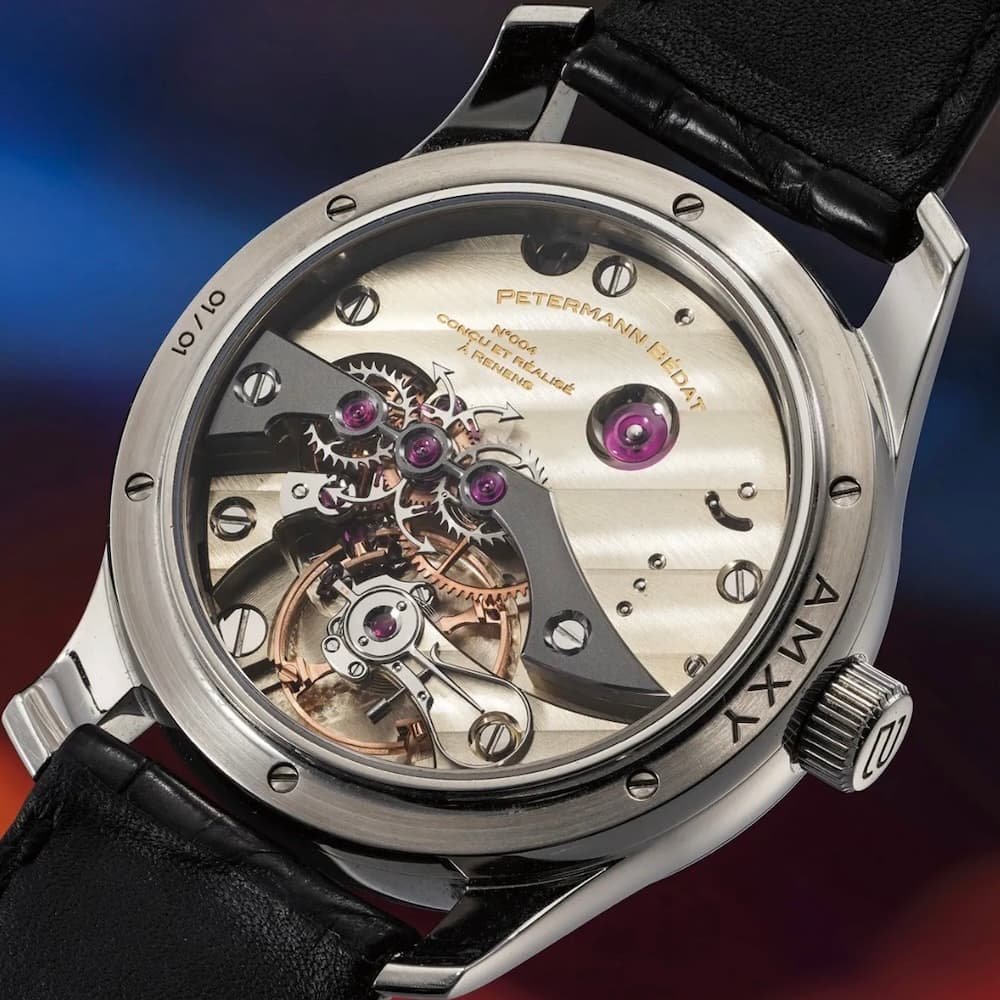
Petermann Bédat: Transmission as a method
From the Geneva school to Renaud Papi
Gaël Petermann and Florian Bédat met at the Geneva watchmaking school, then worked in close collaboration with Dominique Renaud, co-founder of Renaud Papi. This time spent with a central player in contemporary high complications structured their approach: total mastery of the manufacturing chain, advanced manual finishing, and deliberately low production volumes. Their trajectory illustrates how direct transmission between generations of watchmakers remains a vector for renewal, even in a sector dominated by brand communication.
What these trajectories reveal about the sector
Three distinct models of disruption
Creators active since the 2000s do not form a homogeneous movement. Richard Mille operates a disruption through materials and pricing; Ressence, through interface design; Raúl Pagès and Petermann Bédat, through total artisanal mastery and assumed rarity; Greubel Forsey, through documented technical research. These approaches coexist and address distinct segments of collectors, which explains their respective ability to establish themselves long-term without competing head-on.
The rise of independents as a market signal
The creation of the LVMH Independent Creatives Prize in 2024, or the multiplication of auctions dedicated to independent manufactures at Artcurial, Christie’s, Phillips, and Sotheby’s, reflects an economic reality: pieces from these workshops reach price levels comparable to, or even higher than, those of the major historic houses for much smaller series. For a collector or market observer, ignoring this segment means missing a substantial part of contemporary watchmaking creation.