
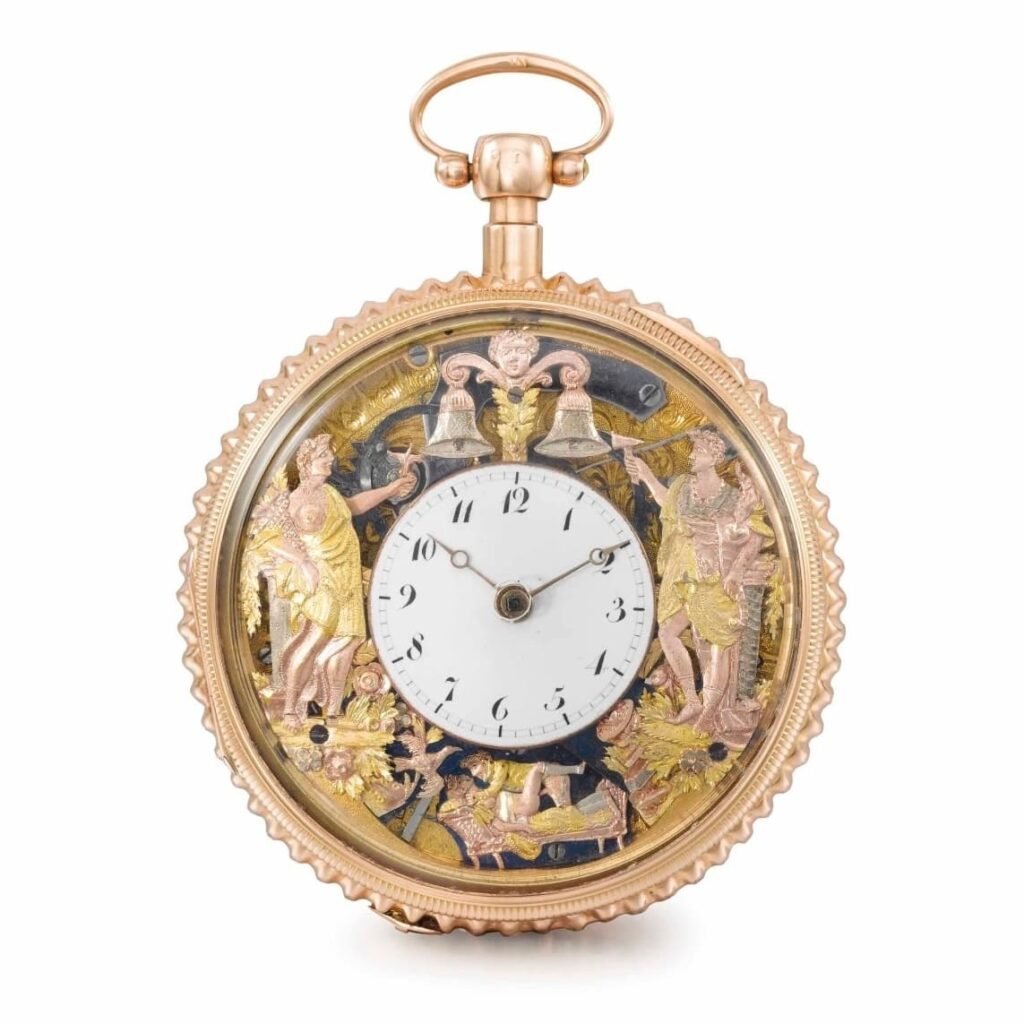
A luxury object with a dual purpose
Erotic automaton watches, sometimes called “risqué watches” or secret watches, form a category of their own in the history of watchmaking. Born in 18th-century France, they combine precision mechanics with licentious depictions, intended for an aristocratic or royal clientele. Their history intersects with that of grand watchmaking complications and a culture of unabashed libertinism.
Origins and historical context
Louis XV’s France, fertile ground
It was under the reign of Louis XV (1715–1774)—a monarch whose amorous life was publicly known—that pocket watches featuring erotic scenes spread through French aristocratic circles. The libertine culture of the time, illustrated by literature (Laclos, Sade) and painting (Fragonard, Boucher), found a natural extension in the decorative arts and luxury watchmaking. These pieces are not mere curiosities: they attest to the expertise of the finest Genevan and Parisian workshops, commissioned to produce objects that were both technically impeccable and visually provocative.
Geneva, a discreet production hub
Geneva as the capital of the gallant watch
Most of these watches were produced in Geneva, a city that then concentrated the finest enamellers and mechanics. The cases feature enamel-painted miniatures depicting mythological or pastoral scenes that appear innocuous, but conceal—beneath a cover or a secret back—explicitly erotic scenes animated by an automaton mechanism. The spring, cams, and levers—the same components that drive the hands—set articulated figurines in motion, reproducing sexual positions. Activation is generally by pressing a pusher or opening a sliding back.
The mechanics of the erotic automaton
Cams and levers in the service of figurative motion
The mechanical principle relies on a system of stacked cams—profiled discs whose irregular outline, as they turn, transmits a specific movement to each limb of the figurine. This process is identical to the one Pierre Jaquet-Droz used for his famous androids of the 1770s (The Writer, The Draughtsman, The Musician), except that the application here is deliberately licentious. A mainspring, wound like that of an ordinary watch, provides the energy. The animation lasts only briefly—anywhere from a few seconds to a few dozen seconds—before the mechanism stops and must be wound again.
Miniaturisation, a true technical challenge
Fitting an automaton into a pocket-watch case
The main constraint is space: an 18th-century pocket watch measures between 45 and 55 mm in diameter, with a thickness of 10 to 15 mm. Integrating a functional timekeeping movement and an automaton mechanism animating several articulated figurines is a tour de force. Watchmakers used stacked plates, very small-module gear trains, and gold or carved-ivory figurines just a few millimetres tall. Some pieces preserved in private or museum collections feature up to three or four independently animated characters.
Major houses and known pieces
Ulysse Nardin, a contemporary heir to this tradition
While 18th-century workshops are often anonymous or attributed to unidentified Genevan “makers,” the tradition continued into the 20th and 21st centuries. Ulysse Nardin is the contemporary manufacture most explicitly associated with this segment, with several collections: the Hourstriker Erotica, the Classic Voyeur, and other references grouped under the generic label of erotic watches. These pieces revive the principle of the pusher-activated automaton, integrated into modern wristwatches or pocket watches, with figurines driven by the striking mechanism or by an independent device.
Andersen Genève, a specialised workshop
Svend Andersen and the watch with gallant complications
Independent watchmaker Svend Andersen, founder of Andersen Genève, has also distinguished himself in this niche field. His workshop produces very limited runs—often fewer than ten pieces per reference—combining serious watchmaking complications (minute repeater, perpetual calendar) with erotic automata. These watches are aimed at discerning collectors, aware of the mechanical rarity as much as the object’s transgressive character. Prices regularly reach several tens of thousands of Swiss francs.
Chopard and Blancpain in the 1980s–1990s
Engraved casebacks with animated automata
In the 1980s and 1990s, Chopard and Blancpain produced wristwatches whose engraved casebacks depicted erotic scenes, with an automaton mechanism for some of the rarest pieces. These engraved and mechanically highly sophisticated watches belong to the tradition of the secret watch with an animated automaton; some were made as unique pieces and represent genuine technical and artisanal feats. They testify to the persistence of this attraction to a watchmaking object with a double reading—restrained on the front, explicit on the reverse with an automaton mechanism.
Heritage status and today’s market
Between private collections and discreet auctions
Pieces rarely displayed, often undervalued
18th-century risqué watches appear in several major museum collections—the International Museum of Horology in La Chaux-de-Fonds preserves a few examples—but public display remains rare for obvious reasons. On the secondary market, these pieces frequently appear in specialised auctions at Christie’s, Sotheby’s, or Antiquorum, where they fetch prices that vary depending on the condition of the automaton mechanism, the quality of the enamelling, and identification of the original workshop. An 18th-century Genevan watch with a working automaton and enamel in good condition can exceed €50,000 to €100,000, depending on recent sales.
An object that questions the boundary between art and mechanics
The risqué watch as a cultural document
Beyond the anecdotal, these watches are first-rate documents on the practices of Europe’s 18th-century elite, on the technical capabilities of Genevan workshops, and on the way luxury watchmaking has always incorporated the desires of its patrons. Their study intersects art history, social history, and the history of technology. For a collector or a watchmaking historian, they represent one of the rare objects in which mechanical prowess and cultural transgression are brought together within a case just a few centimetres across.
What this tradition reveals
The erotic automaton watch is not a marginal curiosity: it illustrates watchmaking’s ability to serve all the desires of its patrons, from the most public to the most private. The continuity between 18th-century Genevan workshops and manufactures such as Ulysse Nardin or Andersen Genève today shows that this segment, however confidential, meets a real and lasting demand. For the serious collector, the interest lies less in the subject depicted than in the mechanical density of an object that must simultaneously tell the time and animate figurines—two constraints that few watchmakers have managed to reconcile with elegance.