
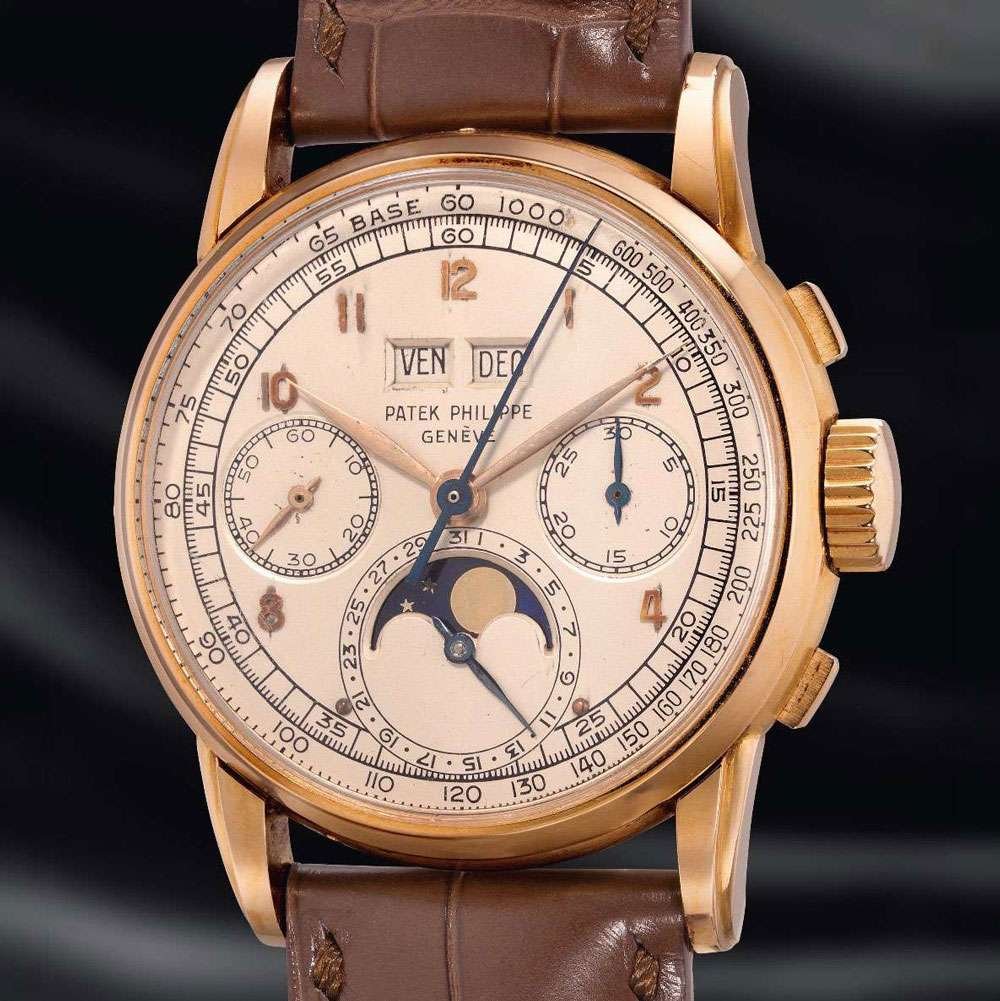
A perpetual calendar chronograph that defined a collecting era
The Patek Philippe ref. 2499 is one of the most studied and sought-after wristwatches ever made. Produced from 1951 to 1985 in only 349 examples across all metals and series, it remains the benchmark against which collectors measure every perpetual calendar chronograph. The first series — distinguished by square chronograph pushers and a tachymeter scale — is the rarest and most historically charged chapter of the reference, and a first-series example, lot 941, is scheduled to appear at Phillips Hong Kong on 30 May 2026.
From ref. 1518 to ref. 2499: a deliberate evolution
The 1518 set the standard, then the 2499 raised it
The ref. 1518, introduced in 1941, was the first serially produced perpetual calendar chronograph wristwatch in history. When Patek Philippe introduced the ref. 2499 in 1951, the two references coexisted briefly — the 1518 remained in production until 1954 — making for a rare overlap of two extremely complex models in the same catalogue simultaneously. The 2499 retained the same movement, calibre 13‑130 (built on a modified Valjoux VZ 23 ébauche), but arrived in a completely redesigned case.
A bassine case that collectors call timeless
Where the 1518 wore a Calatrava-inspired case with thin, elongated lugs typical of 1940s taste, the ref. 2499 adopted a bassine-style case — a slightly cushioned, rounded form — with distinctive fluted lugs. At 37.5mm in its standard configuration, the proportions struck a balance between legibility and elegance that later collectors would describe as the most wearable expression of a perpetual calendar chronograph Patek ever produced. The symmetry of the case is precise: the crown at three o’clock, two square pushers flanking the case at two and four, a dial architecture borrowed directly from the 1518 in the first series.
The four series of the ref. 2499
Each series marks a clear visual break
Patek Philippe updated the ref. 2499 four times over its 34-year run, each revision reflecting the brand’s shifting aesthetic priorities. The changes were incremental but meaningful: pusher shape, dial indices, the presence or absence of a tachymeter scale, and eventually the introduction of a sapphire crystal in the fourth series all serve as dating tools for collectors and auction specialists.
| Series | Approximate dates | Key identifiers |
|---|---|---|
| First | 1951–1960 | Square pushers, applied Arabic or baton numerals, tachymeter scale |
| Second | 1955–1964 | Round pump pushers, Arabic or baton numerals, tachymeter scale, floating date ring |
| Third | 1960–1978 | Round pushers, baton numerals, outer seconds divisions, no tachymeter |
| Fourth | 1978–1985 | Round pushers, baton numerals, shorter outer seconds divisions, sapphire crystal, thicker bezel |
Production numbers that explain current prices
Across all four series and all metals — yellow gold, pink gold, platinum — only 349 examples left the manufacture. That averages roughly ten pieces per year. Of those, just over half have surfaced publicly to date, according to market specialists. The scarcity is structural, not manufactured: the market for such complications in the 1950s and 1960s was narrow, and Patek produced accordingly.
The first series in detail
Square pushers and a tachymeter: the 1518 connection
The first series (1951–1960) is the most direct continuation of the ref. 1518’s visual language. Every example shares three defining traits: square chronograph pushers at two and four o’clock, a tachymeter scale on the outer dial ring, and applied gold Arabic numerals — though some examples carry applied baton indices. The dial layout, the hand design, and the pusher geometry are close enough to the 1518 that a side-by-side comparison reads as a deliberate stylistic handshake between the two references.
Two casemakers, two sub-generations
Within the first series, collectors and researchers identify two distinct sub-generations based on the casemaker. Cases bearing key number 9 were produced by Emile Vichet; those with key number 1 came from Edouard Wenger. The difference is not cosmetic in the superficial sense — both casemakers worked to Patek Philippe’s specifications — but the attribution matters to serious collectors because it adds a layer of provenance and specificity that affects desirability and, consequently, auction results.
Auction results that illustrate first-series premiums
The price differential between a standard yellow-gold first-series example and one in an alternative metal is substantial. A first-series 2499 in yellow gold sold at Bonhams New York in December 2012 for $422,500. Six months earlier, in May 2012, a first-series example in pink gold with a special 37.5mm case hammered at Christie’s for $2.75 million. The metal, the dial variant, and the casemaker attribution each compress or expand that range considerably. At the extreme end of the reference’s market, a platinum 2499 owned by Eric Clapton sold at Christie’s Geneva in 2011 for CHF 3,443,000.
Lot 941 at Phillips Hong Kong, 30 May 2026
A first-series example in a market with limited supply
The appearance of a first-series ref. 2499 at any major auction is a notable event. Given that the entire first series spans roughly a decade of production and shares the same movement and case architecture across a small number of surviving examples, each auction appearance represents a finite opportunity. Phillips Hong Kong’s lot 941, offered on 30 May 2026, belongs to the most historically significant chapter of the reference — the period when the 2499 was still visually anchored to the 1518 it replaced, before the round pushers and revised dial of the second series shifted the design toward a more modern sensibility.
What to examine before the sale
For any first-series 2499, condition assessment follows a consistent checklist. The tachymeter scale should be legible and unfaded; applied Arabic numerals should sit flush and show no signs of regluing; the square pushers must be original and unpolished, as case polishing destroys the sharp angles that define the series. The case back, movement, and dial should carry matching serial numbers, and the casemaker key number — Vichet (9) or Wenger (1) — should be confirmed. A Patek Philippe Extract from the Archives, confirming original metal and configuration, is the documentary baseline for any serious bidder.
Why the first series commands its own category
Rarity within rarity, and the 1518 bridge
Of the 349 ref. 2499s produced, the first series represents a fraction — roughly the output of the first decade of production, at an average of ten pieces per year across all metals. Within that group, pink gold and platinum examples are exceptional; yellow gold is the baseline. The first series also carries a historical argument that no later series can replicate: it is the only group of 2499s that a collector in 1955 could have placed next to a late 1518 and seen a direct visual lineage. That continuity is now a collecting argument in itself.
The 2499 as the blue-chip benchmark
Market specialists have described the ref. 2499 as “the blue chip of blue chips” for Patek Philippe collectors. The logic is straightforward: extreme rarity, a 34-year production run that generated only 349 examples, four clearly differentiated series that reward deep knowledge, and a movement — cal. 13‑130 — that represents the apex of mid-century Swiss complication work. When first-series examples surface, the pool of informed buyers is deep and the supply is not. That asymmetry has driven prices consistently upward since the early 1990s, when a first wave of serious collectors began competing for the best examples.
A position on the first series
The first-series ref. 2499 is not simply the earliest chapter of a great reference — it is the point at which Patek Philippe demonstrated that the perpetual calendar chronograph could evolve without abandoning the visual grammar that made the 1518 canonical. The square pushers, the tachymeter scale, and the applied Arabic numerals are not anachronisms; they are the evidence of a deliberate transition. For a collector who wants to understand the full arc of the 2499, the first series is the necessary starting point. For a collector who wants one watch that concentrates the most historical weight, the casemaker attribution, and the strongest visual link to the 1518, the first series is the only answer.