
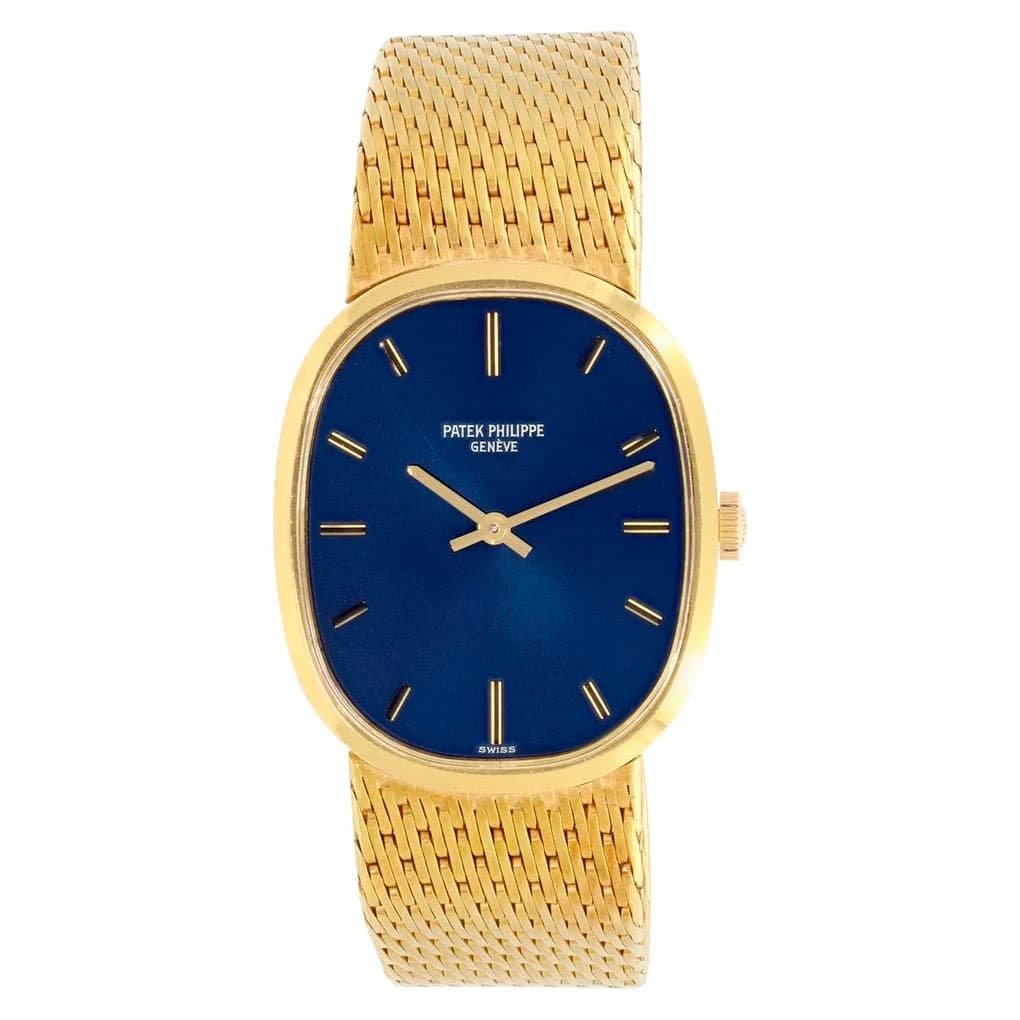
Birth of an Iconic Form, 1968
The Golden Ellipse was born in 1968, at a moment when Patek Philippe sought to offer a modern alternative to the classic round wristwatch. Founded on the golden ratio—that mathematical proportion of 1.618 which governs the architecture of the Parthenon as well as natural spirals—its elongated oval form responds to a precise geometric logic, not to stylistic whimsy. The two founding references, the 3546 and the 3548, immediately defined two distinct interpretations of a single formal principle.
The Origin of the Design: American Highways or the Golden Ratio
The genesis of the form has long fueled internal debate at Patek Philippe. Part of the team attributed the inspiration to the aerial view of American highway interchanges, whose curves recall the ellipse. Official communications, meanwhile, have always emphasized the golden ratio as the guiding principle. The truth draws from both: the highways may have helped the form take shape, but it was indeed the golden ratio that fixed the final proportions of the case. Period advertisements explicitly cited the Parthenon to anchor the model in a millennial aesthetic tradition.
The 3546 and the 3548: Two Readings of a Single Geometry
Launched simultaneously, references 3546 and 3548 embody two opposing temperaments. The 3546 incorporates lugs—those case extensions that receive the bracelet—which gives it a more assertive lateral presence and immediate legibility as a conventional wristwatch. The 3548, by contrast, eliminates all lugs: the elliptical case extends directly into the integrated bracelet, without visual interruption. This continuity of line makes the 3548 the most radical and purest version of the concept. Today, it is the one that collectors and horological historians regard as the emblematic reference of the founding duo.
The Movement: From Manual Mechanics to Ultra-Thin Automatic
The original 3546 is powered by the calibre 23-300, a manual movement that ensures a contained thickness, consistent with the dress vocation of the model. In 1977, Patek Philippe took a decisive step by integrating the calibre 240—an ultra-thin automatic movement with micro-rotor—into the Ellipse family. This calibre, whose thickness does not exceed 2.53 mm, makes it possible to preserve the slim silhouette that defines the model’s identity without sacrificing the convenience of automatic winding. This is one of the rare instances where a technical evolution reinforces, rather than compromises, the formal coherence of a design.
The “The $1,700 Trust Fund” Campaign: An Advertising Rupture
The Golden Ellipse was accompanied by an advertising campaign that broke radically with Patek Philippe’s habits. The Genevan house, renowned for its discretion and classicism, chose a provocative tagline: “The $1,700 Trust Fund.” The message positioned the watch as a transferable investment between generations, but the tone—direct, almost irreverent—was unprecedented for a manufacture that had until then communicated in absolute restraint. This advertising risk signals that the Ellipse is not merely a horological object: it is also a cultural statement, addressed to an American clientele sensitive to the idea of enduring value.
An Ecosystem of Products Around a Single Motif
The strength of the elliptical design is measured by its capacity to migrate to other objects. Around the watch, Patek Philippe developed a line of accessories—cufflinks, key rings, lighters, table clocks—all rendered in the same oval form. This phenomenon is rare in the manufacture’s history: few models have generated such an ecosystem of derivative products, which testifies to the coherence and immediate legibility of the motif.
The Vintage Market and the Post-2018 Rediscovery
For decades, the Golden Ellipse remained in the shadow of the Nautilus, launched in 1976 by Gérald Genta and now one of the most speculated watches on the secondary market. The Ellipse’s 50th anniversary in 2018 marked a turning point: Patek Philippe released reference 5738R “Grande Taille” in rose gold with onyx dial, followed by the 5738/50P with hand-engraved dial. These releases reignited interest in vintage versions. According to market observers, the 2020 pandemic further accelerated this resurgence: collectors, saturated by overvalued references, turned toward “overlooked” models offering genuine historical value at still-accessible prices. The earliest references—3546 and 3548—are now firmly anchored in vintage territory, with over forty years of age.
What Distinguishes the 3548 in Today’s Market
For a collector weighing the two founding references, the 3548 without lugs presents a clear aesthetic advantage: the total integration of the bracelet into the case creates a visual coherence that the 3546 does not achieve. In practice, examples in excellent condition—golden or blued dials without oxidation or repainting—remain the most sought-after. Specialists recommend prioritizing dials in perfect original condition, as restoration of a vintage dial significantly degrades value. The 3548 thus constitutes the most pertinent entry point for anyone wishing to own the Ellipse form in its most integral version, before demand catches up with that of the Nautilus.