
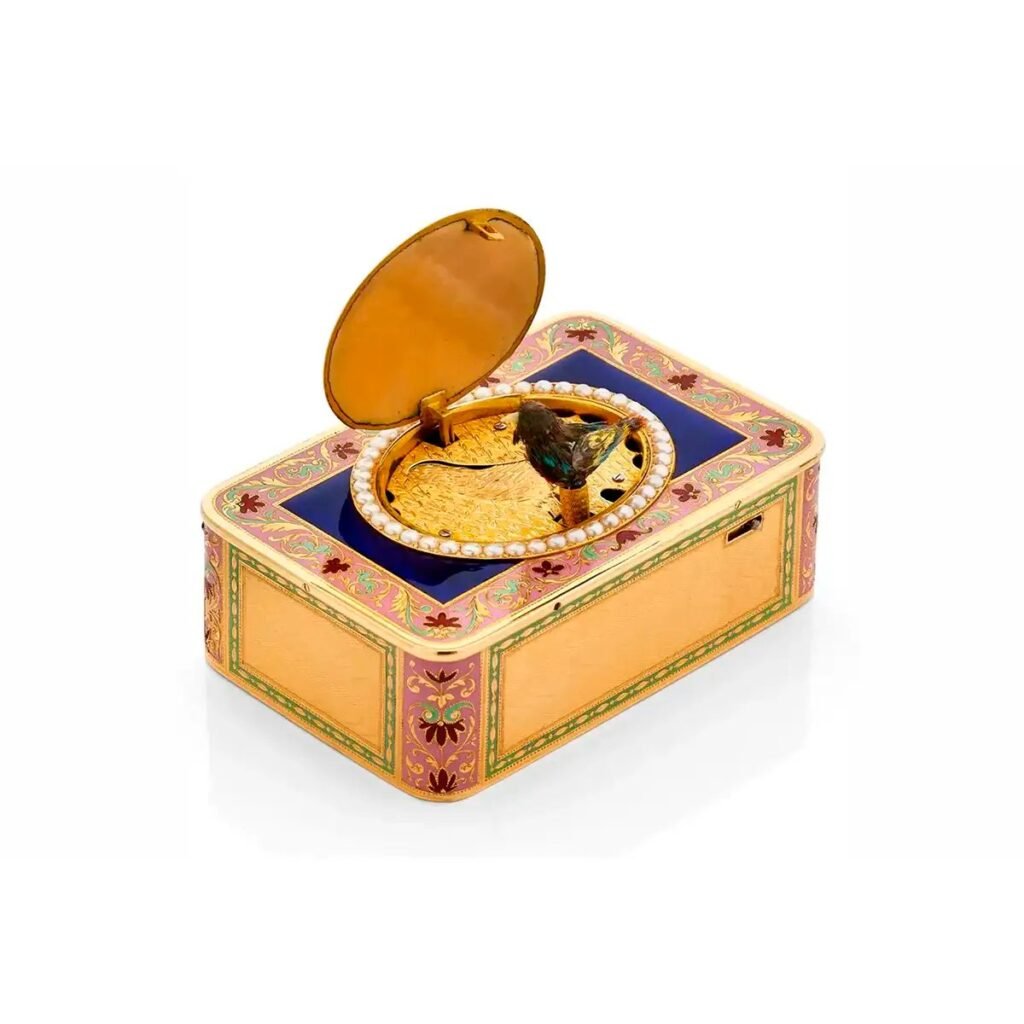
The world of horological automata represents one of the pinnacles of Swiss mechanical art, with singing birds as iconic figures. From Pierre Jaquet-Droz to the Rochat brothers, these animated mechanical creations bear witness to exceptional technical ingenuity and artistic craftsmanship that continues to influence contemporary watchmaking.
The Origins of Jaquet-Droz Automata
Pierre Jaquet-Droz, an 18th-century Swiss watchmaker, distinguished himself through the creation of sophisticated automata that fascinated European royal courts. His most famous creations include three mechanical androids preserved at the Musée d’Art et d’Histoire in Neuchâtel: the Writer, the Draughtsman, and the Musician. The Writer, considered the ancestor of modern computers, contains over 6,000 components and can be programmed to write up to 40 characters.
Singing Birds: A Horological Specialty
While Jaquet-Droz’s androids are famous, the majority of his automata featured singing birds. These creations, known as “singing bird boxes,” featured mechanical birds capable of pirouetting, flapping their wings, and singing thanks to a system of bellows and tiny organ pipes. These pieces operate on an ingenious mechanical principle: a spring mechanism activates a bellows that pumps the air needed to produce the bird’s song.
The Legacy of the Rochat Brothers
The Rochat brothers, Genevan watchmakers of the early 19th century, perfected the art of singing birds after working with the Jaquet-Droz family. They created some of the finest examples of bird automata, often adorned with real feathers and housed in glass cages or urns that allowed the mechanism to be admired. A clock attributed to Jaquet-Droz and Leschot, dating from 1785, features a particularly remarkable bird that not only opens its beak, flaps its wings, and wags its tail, but also hops from perch to perch.
Exporting to Asia
Singing bird automata were the primary product that Jaquet-Droz exported to China, making him a commercial pioneer. Through a relationship with the trading company James Cox London, Jaquet-Droz became one of the first Swiss watch brands imported into China, India, and Japan. This expansion into Asian markets contributed to the international renown of these mechanical creations.
The Contemporary Renaissance
The modern Jaquet Droz brand, although having no direct link to the original family, has perpetuated this heritage since its acquisition by the Swatch Group in 2000. It has a division entirely dedicated to the research, development, and manufacture of automata. The “Charming Bird” watch, the first wristwatch to integrate a singing bird automaton, won the Mechanical Exception prize at the Grand Prix d’Horlogerie de Genève in 2015.
Contemporary Masterpieces
Among Jaquet Droz’s recent creations, “The Bird Repeater” stands out as a synthesis of its glorious technical and scenographic past. This watch features hand-painted birds in their natural habitat on its dial, with a minute repeater mechanism that animates the scene: parent birds feed their young and spread their wings while a waterfall flows in the background. An unhatched egg in the nest even opens to reveal a hungry chick.
Artistic and Technical Value
These contemporary automaton watches represent much more than mere timepieces. They are mechanical works of art that tell a story and demonstrate exceptional craftsmanship. The mechanical precision required to animate these miniature scenes contrasts with the playful effect they produce, creating a unique emotional experience for the observer.
Preserved Cultural Heritage
Jaquet Droz automata, whether historical or contemporary, embody the intersection of art and technology. These exceptional pieces, though far removed from the world of utilitarian watches, perpetuate a unique watchmaking tradition that continues to fascinate collectors and mechanical art enthusiasts worldwide.