
A horological masterpiece born from a secret passion
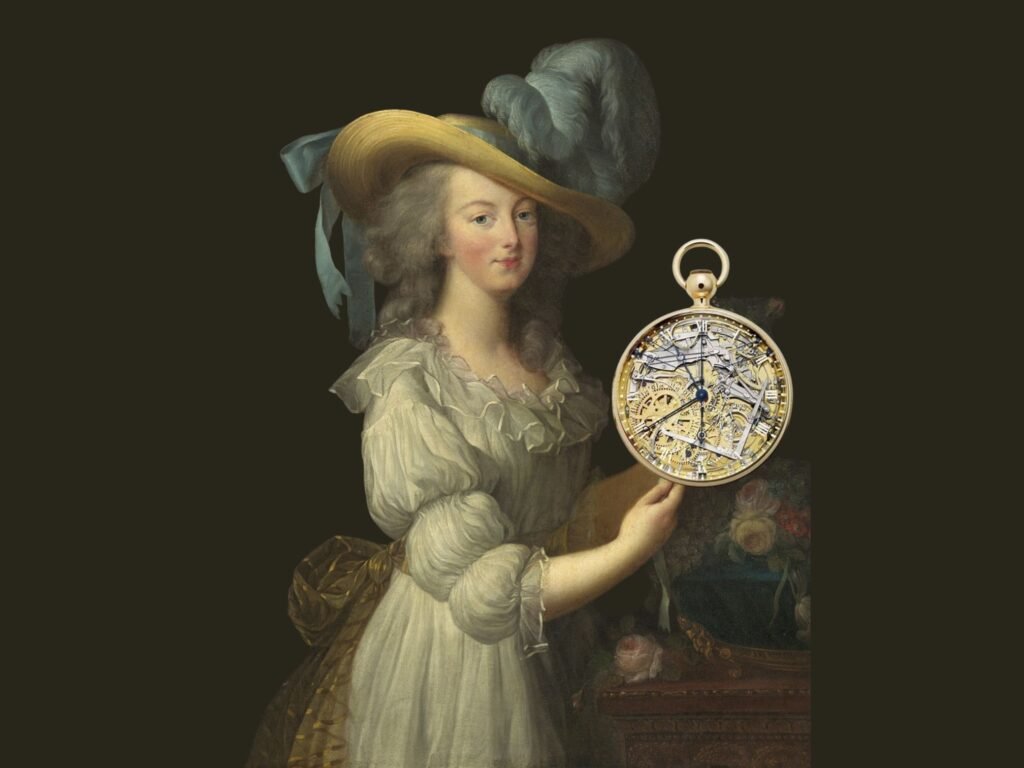
The Breguet No. 160 watch, nicknamed “Marie-Antoinette,” represents one of the pinnacles of global watchmaking art. Commissioned around 1783 by a secret admirer of the queen, likely the Swedish Count Hans Axel von Fersen, this extraordinary piece was intended to embody its patron’s eternal love for the sovereign. The project was as ambitious as the instructions were simple: create the most complex watch possible, use gold wherever technically feasible, and take all the time necessary to achieve perfection.
A creation that transcends time
The creation of this exceptional pocket watch spanned 44 years, far exceeding the lives of its initial protagonists. Neither Marie-Antoinette, guillotined in 1793, nor Abraham-Louis Breguet, who died in 1823, lived to see the completion of this masterpiece. It was Antoine-Louis Breguet, the master’s son, who finally finished the watch in 1827, giving birth to what was then the most complex timepiece in the world – a title it held for 77 years.
A compendium of horological complications
With its 823 components, the No. 160 brought together all the horological complications known at the time. This 63 mm diameter timepiece displays jumping hours and central minutes, an independent central seconds hand (a primitive form of chronograph), running seconds at six o’clock, a complete perpetual calendar with the month at eight o’clock, the day at six o’clock, and the date at two o’clock. Additionally, it features the equation of time at ten o’clock, a 48-hour power reserve indicator at eleven o’clock, and even a thermometer at one o’clock.
A sonic and mechanical feat
The watch not only displays time but also makes it audible. Equipped with a minute repeater, it strikes the hours, quarter-hours, and minutes on demand. Its automatic movement, powered by an imposing rotor, represented a major technical innovation for its era. True to the patron’s instructions, Breguet used gold wherever possible, replacing components typically made of steel or brass with the precious metal.
The spectacular theft and mysterious reappearance
The modern history of the No. 160 is as fascinating as its creation. After belonging to several prestigious collectors, including Sir David Salomons, the watch was bequeathed to the L.A. Mayer Museum for Islamic Art in Jerusalem. In 1983, it disappeared during a spectacular burglary that remained unsolved for decades. The thief, Naaman Diller, kept the piece until his death, after which his widow secretly negotiated its return to the museum in 2006.
The rebirth: the creation of the No. 1160
In 2004, while the original watch was still considered lost, Nicolas G. Hayek, President of the Swatch Group and owner of Breguet, launched an ambitious project: to completely recreate the Marie-Antoinette. Without access to the original plans, a small team at the Breguet Manufacture undertook to design each component, relying on the company’s archives, the writings of George Daniels, and the study of another complex Breguet watch, the Duc de Praslin’s watch.
The royal case from a historic oak
The project took on an additional symbolic dimension when Marie-Antoinette’s favorite oak tree at Versailles, damaged by bad weather, had to be felled. Breguet obtained this historic wood to create an exceptional case for the new watch. In recognition, Hayek funded the complete restoration of the Petit Trianon, the queen’s favorite residence at Versailles, for an amount of 5.5 million euros.
The presentation to the world
On April 4, 2008, Nicolas G. Hayek proudly unveiled the No. 1160 at the Baselworld exhibition before the international press. By an extraordinary coincidence, the original watch had resurfaced a few months earlier, in November 2007, when the Israeli museum finally announced its recovery. Thus, after more than two centuries, the world could once again admire not one, but two Marie-Antoinettes.
The legacy of a masterpiece
The Breguet No. 160 and its modern twin, No. 1160, embody the pinnacle of watchmaking art. They represent not only exceptional technical prowess but also privileged witnesses to history. These watches perfectly illustrate the philosophy of Abraham-Louis Breguet, whose revolutionary approach transformed horology and continues to inspire the contemporary creations of the house that bears his name.
An inestimable value
Today, the No. 1160 is rarely presented to the public. As for the original, it remains one of the most precious pieces of global horological heritage. These two watches belong to the pantheon of the most important timepieces ever created, alongside Patek Philippe’s Calibre 89, George Daniels’ Space Traveler, and Vacheron Constantin’s reference 57260. They symbolize the pursuit of absolute excellence that drives great watchmakers throughout the centuries.