
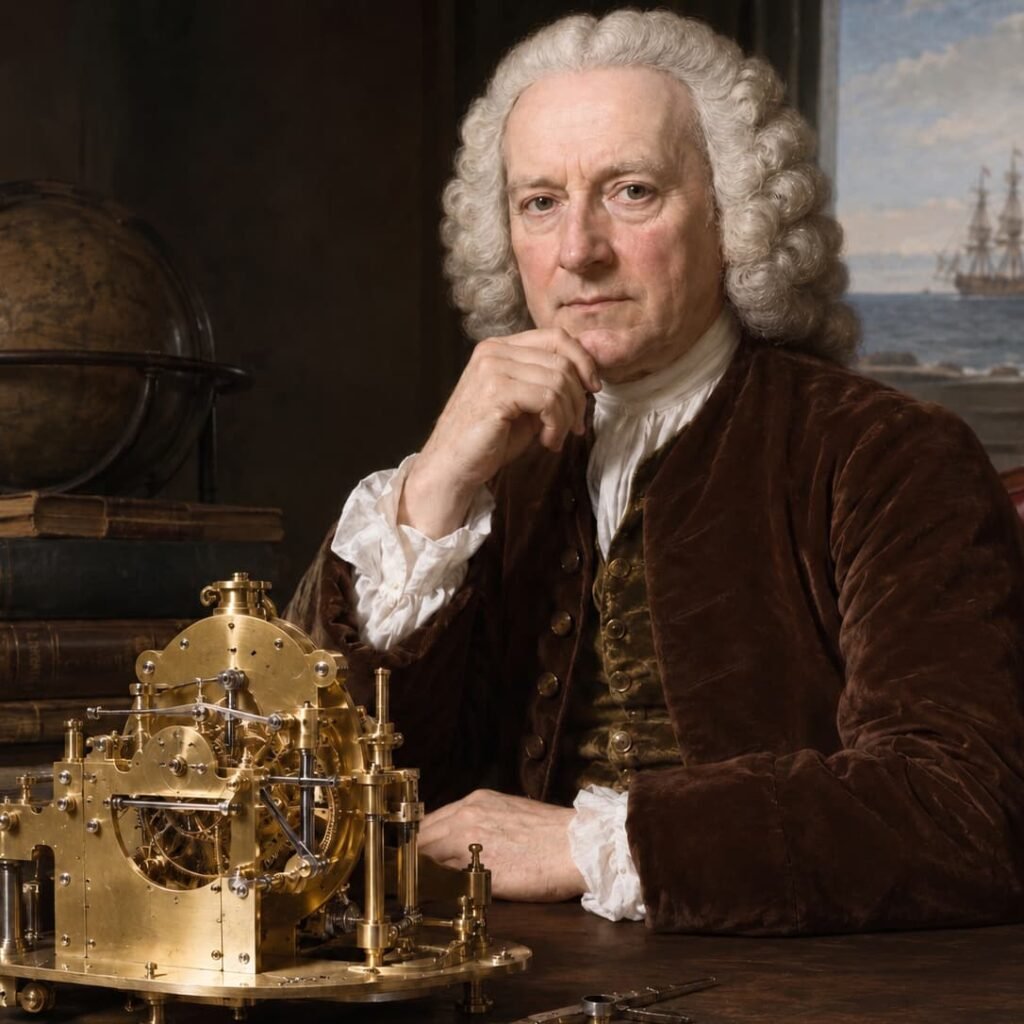
A device born from a fundamental problem of regularity
The remontoire addresses one of the oldest constraints in mechanical watchmaking: the driving torque of a mainspring decreases as it unwinds, leading to a drop in balance wheel amplitude and, consequently, timing drift. Invented in its spring-driven form by John Harrison in the 18th century, this mechanism has since been revisited, refined, and integrated into some of the most complex watches on the market today.
The problem the remontoire solves
As a mainspring unwinds, it gradually transmits less energy to the balance wheel. This drop in amplitude is not merely theoretical: it directly affects rate stability, as no real balance wheel behaves perfectly isochronously—that is, independently of its oscillation amplitude. The less the balance wheel oscillates, the more unstable the timing becomes.
Jost Bürgi and the first gravity remontoire solutions
The first forms of remontoires appeared in precision horology as early as the late 16th century. Swiss clockmaker Jost Bürgi (1552–1632), faced with the extreme sensitivity of the verge escapement to torque variations, developed a gravity remontoire for his astronomical clocks. This device allowed him to achieve a precision of about one minute per day—a remarkable performance for the time, especially without a hairspring, which did not yet exist.
John Harrison and the invention of the spring remontoire
It was John Harrison (1693–1776), builder of the first reliable marine chronometer, who invented the spring remontoire and applied it to a watch for the first time. He integrated this mechanism into his second sea clock prototype, H2. In H4—officially recognized as the first successful marine chronometer, tested at sea in 1761 with spectacular results—the remontoire rewinds every 7.5 seconds. The principle is as follows: a small secondary spring, much weaker than the mainspring, is placed within the gear train. The mainspring rewinds it at regular intervals. As long as the mainspring has enough energy to rewind this auxiliary spring, the torque transmitted to the escapement remains constant, regardless of the mainspring’s state of wind.
How the mechanism works in practice
A secondary spring as an energy buffer
In practice, the remontoire places a secondary spring on one of the gear train pinions, between the mainspring and the escapement. This spring is rewound at fixed intervals—ranging from a few seconds to several minutes depending on the caliber. The escapement and balance wheel receive their energy only from this buffer spring, whose torque is much more stable than that of the mainspring as it unwinds. The duration between two rewinds defines the granularity of the regulation: the shorter the interval, the more uniform the energy delivered.
An inherent limitation of the classic device
However, the classic remontoire has a residual imperfection: even the secondary spring does not deliver perfectly constant torque between two rewinds—it also unwinds slightly. This point led Greubel Forsey to develop the Différentiel d’Égalité, a mechanism ‘of the remontoire class’ in the words of Stephen Forsey, but which uses a two-output differential system to provide theoretically perfectly uniform energy to the escapement. One output powers a deadbeat seconds hand, while the other directly powers the escapement.
Contemporary relevance and current applications
Limited practical interest for modern automatic watches
In an automatic wristwatch worn daily, the remontoire offers little practical utility. Modern mainspring alloys (such as Nivarox) provide a much flatter torque curve than old steels. Furthermore, the automatic winding mechanism keeps the spring within a relatively stable tension range, which is itself a form of torque equalization. In this context, the remontoire is more of a connoisseur’s complication than a functional necessity.
Use cases where the remontoire remains relevant
Nevertheless, there are situations where the remontoire retains a real technical justification. In F.P. Journe’s Chronomètre à Résonance, each gear train has its own one-second remontoire, visible at 3 o’clock and 9 o’clock on the dial, respectively. The reason is precise: in a resonance watch, the two balance wheels must remain synchronized. Any variation in amplitude risks breaking this synchronization. The remontoire maintains constant amplitude, stabilizing the resonance coupling between the two oscillators—an essential condition for the principle to function correctly.
The remontoire applied to the tourbillon: Pratt’s challenge
Another notable contemporary application involves combining the remontoire with a rotating tourbillon. Watchmaker Derek Pratt, whose work was published in the Horological Journal in 1991, focused on the difficulty of delivering a regular impulse to a constantly moving tourbillon. He drew on the work of Thomas Mudge, John Harrison, and George Daniels—the latter having designed a 15-second remontoire under the tourbillon of an unfinished watch—to develop a remontoire mounted directly on the tourbillon carriage. This solution reduces the distance between the secondary spring and the escapement, thereby maximizing the regularity of the impulse.
What distinguishes the remontoire from other regulation solutions
A mechanical approach, not electronic or material-based
Unlike the progress made by anti-magnetic alloys or silicon, the remontoire is a purely mechanical solution to the problem of variable torque. It does not improve resistance to external disturbances (magnetism, temperature) but acts directly on the source of instability: the energy variation upstream of the escapement. It is this fundamental mechanical nature that explains both its historical longevity and its appeal to high-precision watchmakers.
A demanding mechanism, reserved for limited production
The remontoire remains uncommon in mainstream production, not due to a lack of theoretical interest, but because it is delicate to design, adjust, and produce on an industrial scale. Its presence in a caliber generally signals an independent manufacture approach, oriented toward precision chronometry rather than volume. Contemporary examples—F.P. Journe, Greubel Forsey, Urban Jürgensen—confirm this logic: the remontoire remains the preserve of workshops capable of absorbing the complexity it imposes, and who choose to integrate it because the technical context truly justifies it.