
Two Swiss icons, a unique horological object
Announced in Biel in May 2026, the Royal Pop is the result of a collaboration between Audemars Piguet, a manufacture founded in 1875 in Le Brassus, and Swatch, the watchmaking group responsible for democratizing “Swiss Made” and reviving the mechanical watch in the 1980s. The collection consists of eight Swiss Made bioceramic models, powered by a manual-winding version of the SISTEM51 movement, and is presented as a pocket watch—a first for both houses. The following details the technical, aesthetic, and symbolic logic of this project.
What the Royal Pop borrows from each house
The 1972 Royal Oak as a starting point
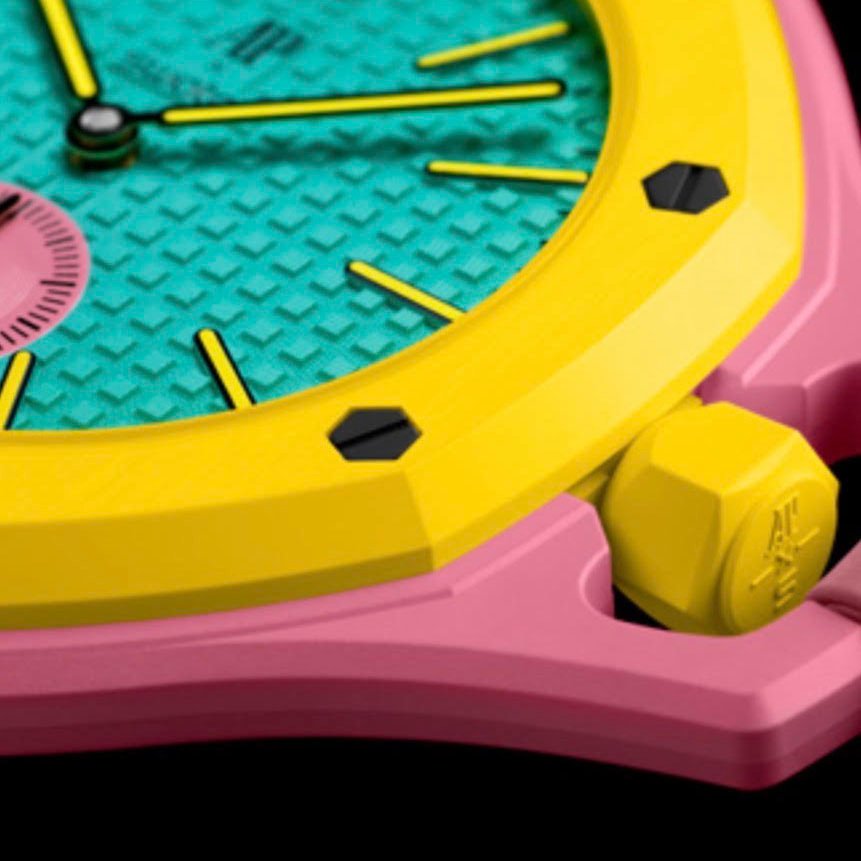
Audemars Piguet’s Royal Oak, designed by Gérald Genta and launched in 1972, established two immediately recognizable features: a rounded octagonal case and a bezel secured by eight visible screws. These two elements directly structure the Royal Pop. The number of models in the collection—eight—is not arbitrary: it explicitly refers to the eight sides of the case and the eight screws of the original bezel. The construction of the Royal Pop case required eight additional patents due to the geometric complexity inherited from the Royal Oak, which combines a rounded octagon, a circle, and a tonneau shape within a single volume.
The Swatch POP of the 1980s as an aesthetic reference
The collection also draws inspiration from the Swatch POP, born in the second half of the 1980s and characterized by bright colors, accessibility, and a relaxed approach to wearing a watch. The Royal Pop captures this spirit by offering distinct colors for each of the eight models, visible on both the dial and the transparent caseback, which reveals the movement.
The SISTEM51 movement in a manual-winding version
A caliber entirely assembled by automated systems
The SISTEM51 is the only Swiss Made mechanical movement whose assembly is fully automated. Developed by the Swatch Group, it consists of 51 components grouped into five modules, hence its name. For the Royal Pop, Swatch offers a unique manual-winding version, incorporating 15 active patents. The technical specifications include: a power reserve of over 90 hours, a Nivachron™ anti-magnetic balance spring—the same alloy used in many Audemars Piguet watches—and precision adjustment performed by laser directly at the factory, without manual intervention on the balance spring.
A patented power reserve indicator on the barrel
One of the eight new patents concerns the visual display of the power reserve via the barrel drum—the component that stores the spring’s energy. When the barrel chambers appear gray, the spring coils are visible: the watch needs to be wound. When they take on a golden hue, the spring is compressed and the watch is fully charged. This device is both functional and visible through the transparent caseback of each model.
Two dial configurations for eight models
Six Lépine models, two Savonnette models
The collection is divided into two types of pocket watches, according to classic horological terminology. The Lépine style places the winding crown at 12 o’clock and features a two-hand dial (hours and minutes): six models adopt this format. The Savonnette style positions the crown at 3 o’clock and adds a small seconds counter at 6 o’clock: two models are offered in this configuration. The small seconds—a seconds hand housed in a separate sub-dial—is a classic complication of the traditional pocket watch, here reinterpreted in a colorful bioceramic case.
A deliberately versatile and unconventional way to wear
Three strap lengths and a desk stand
The Royal Pop comes with a calfskin strap with contrast stitching, available in three different lengths. This choice of format—a pocket watch rather than a wristwatch—allows for several ways to wear it: around the neck, on the wrist, in a pocket, or attached to a bag. A small removable stand also allows it to be placed on a desk as a desk watch. This positioning breaks with segment conventions: neither the Royal Oak nor standard Swatch watches offer this type of structural versatility in how they are worn.
What this collaboration means for both houses
A precedent in the history of horological collaborations
The collaboration between the Swatch Group and a haute horlogerie manufacture is not without precedent: the MoonSwatch project, launched in 2022 with Omega, demonstrated the commercial and media viability of this type of association. The Royal Pop differs in several ways: the pocket watch format is new to both catalogs, bioceramic replaces the usual Swatch plastic, and the number of patents filed—eight for the case, fifteen for the movement—indicates a level of technical investment superior to a simple co-branding operation.
Positioning between haute horlogerie and popular culture
For Audemars Piguet, associating the Royal Oak—whose steel references regularly trade between €20,000 and €50,000 on the secondary market—with a bioceramic object powered by a SISTEM51 is a deliberately disruptive positioning choice. For Swatch, the Royal Pop represents a technical and symbolic move upmarket, driven by new patents and a material more noble than plastic. The result is an object that belongs fully neither to the haute horlogerie segment nor to that of the mass-market watch, and it embraces this ambiguity as a founding principle.
Key takeaways from the Royal Pop
The Royal Pop is technically consistent—the manual SISTEM51 with Nivachron™ balance spring, the 90-hour power reserve, and the case patents bear witness to this—and symbolically clear: eight models, eight screws, eight patents, everything refers back to the founding geometry of the Royal Oak. The pocket watch format, combined with the multi-wear strap, represents the true departure of this collection from the conventions of both houses. For a collector, the interest lies less in the object’s value—difficult to predict for such an atypical item—than in the technical project’s coherence and the rarity of the format in the recent history of Swiss watchmaking.