
A record sale in the United States in April 2026
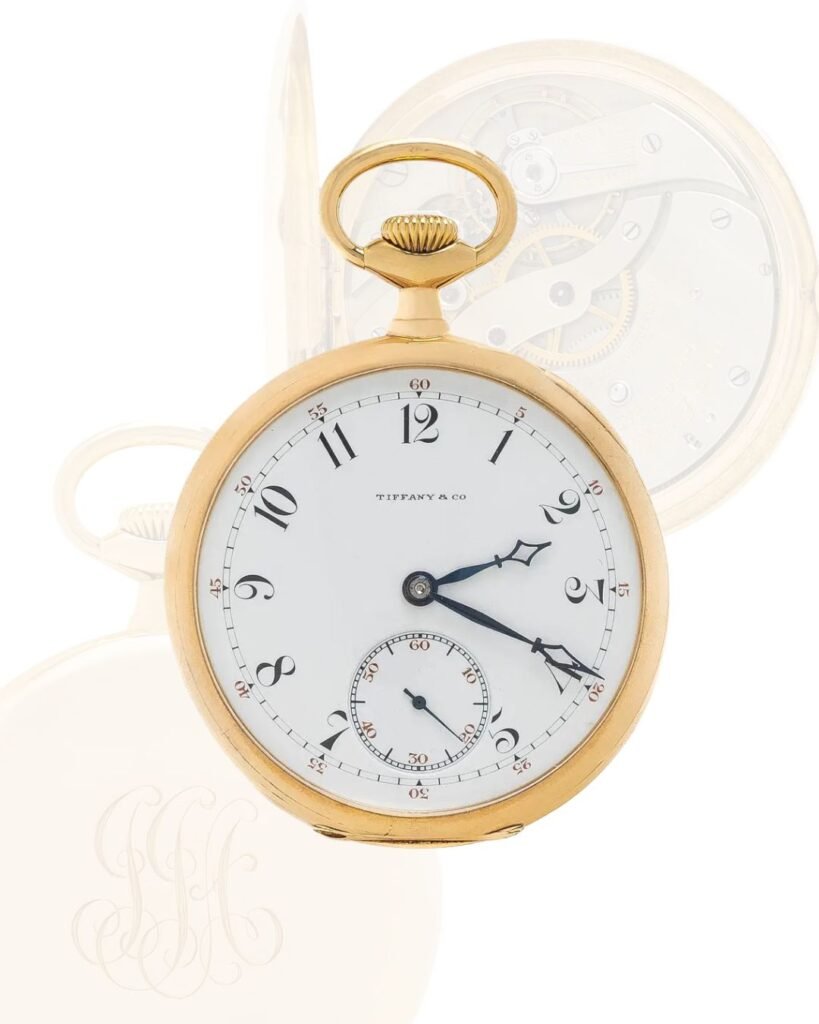
Freeman’s sold, on April 22, 2026, in Chicago, the Patek Philippe for Tiffany & Co. pocket watch found on John Jacob Astor IV’s body after the sinking of the RMS Titanic in 1912. The final price exceeded $1 million, setting a record for a U.S.-based auction of items linked to the disaster. This transaction illustrates the momentum of the Titanic memorabilia market, where documented, unbroken provenance outweighs an object’s intrinsic value.
John Jacob Astor IV, the Titanic’s wealthiest passenger
Born in 1864, John Jacob Astor IV was one of the wealthiest men in the United States in the early 20th century, heir to a colossal real-estate fortune built on Manhattan. He boarded the Titanic in Cherbourg on April 10, 1912, with his wife Madeleine, 18, after a honeymoon trip to Europe and Egypt. The couple was returning to the United States so that their unborn child could be born on American soil. During the sinking, on the night of April 14–15, 1912, Astor helped Madeleine into lifeboat No. 4. Asked by Second Officer Charles Herbert Lightoller whether he could board with her, he was told that no men would be taken aboard until all women and children were safe. He kissed Madeleine, told her, “I will meet you in New York,” and then stepped aside. Witnesses saw him wave to her from the deck. He was 47.
A body recovered with personal effects inventoried
Astor’s body was recovered on April 22, 1912, by the crew of the cable ship Mackay-Bennett, chartered from Halifax by the White Star Line to retrieve victims floating in the North Atlantic. The inventory drawn up on board was precise: a gold watch, gold and diamond cufflinks, a three-stone gold and diamond ring, a gold pen, as well as cash. His eldest son Vincent Astor and Nicholas Biddle, executor of the estate, recovered the body and personal effects in Halifax before returning to New York. This rigorous documentation, established as early as 1912, is now the main provenance argument underpinning the watch’s exceptional market value.
A Patek Philippe pocket watch for Tiffany & Co., circa 1904
The watch sold by Freeman’s is an 18k yellow-gold Patek Philippe pocket watch, retailed by Tiffany & Co. in New York, dating to around 1904. Its technical specifications are precisely documented: case number 235274, movement number 129029, approximately 44 mm case, white enamel dial, manual-wind movement. The inner caseback bears the signature “TIFFANY & CO. 235274”; the movement is stamped “MADE IN SWITZERLAND No. 129029 Tiffany & Co.”; the outer caseback is engraved with the JJA monogram. The watch was sold with an extract from the Patek Philippe archives, an official document issued by the Geneva manufacture certifying the production and sales details.
The Patek Philippe and Tiffany & Co. partnership since 1851
The association between Patek Philippe and Tiffany & Co. dates back to 1851, when Antoine Norbert de Patek and Charles Lewis Tiffany established a business relationship that continues to this day. Patek Philippe pocket watches “retailed by Tiffany”—that is, distributed and signed by the jeweler—form a distinct category in the vintage watch market, regularly valued above unsigned examples. The dual Patek Philippe / Tiffany & Co. signature on the movement and case of Astor’s watch strengthens its authenticity and desirability among collectors specializing in both houses.
An unbroken chain of ownership spanning more than a century
The watch’s traceability is one of its most decisive strengths. Purchased by John Jacob Astor IV at Tiffany & Co.’s flagship store in New York around 1904, it was recovered from his body in 1912 and passed to his son Vincent Astor (1891–1959), who wore it until his death. Brooke Astor (1902–2007), Vincent’s wife, inherited it next, then her son Anthony Marshall (1924–2014), and finally the latter’s wife, Charlene T. Marshall (1945–2024). It was the estate of Charlene Marshall, who died in 2024, that consigned the watch to Freeman’s for this sale. Five generations, a single direct family line, no documentary gaps: few Titanic-related objects have provenance that is so continuous and verifiable.
A steadily growing market for Titanic memorabilia
Freeman’s sale fits into a well-established market trend. In November 2025, the pocket watch presented to Captain Arthur Rostron of the RMS Carpathia—the ship that rescued 705 survivors—sold for £1.56 million (about $1.97 million) at a Henry Aldridge & Son auction, setting a new all-time record for any Titanic-related object. This Touchon watch, made in Geneva, had been presented to Rostron by three first-class widows, including Madeleine Astor herself, at a luncheon held on May 31, 1912—less than two months after her husband perished in the sinking. The link between the two watches is therefore direct: one belonged to Astor, the other was presented in his memory by his widow.
What determines the value of a Titanic-related object
Three factors shape prices in this segment: documented, unbroken provenance; the identity of the original owner—his or her notoriety, social standing, role during the sinking—and the rarity of the object on the public market. Astor’s watch combines all three criteria: an official 1912 inventory, a leading figure among the victims, and its first public sale in the United States after more than a century of family transmission. The Patek Philippe archives extract included with the lot adds an additional layer of certification that is essential for watches from the Geneva watchmaking manufacture.
Provenance as a price driver in watch auctions
This type of result goes far beyond the circle of vintage watch collectors. Buyers are often history collectors, museum institutions, or brands looking to enrich their archives—such as Tiffany & Co., which acquired Captain Rostron’s watch to display it at house events. For a collector or an auctioneer, the conclusion is unambiguous: a circa-1904 Patek Philippe pocket watch, even retailed by Tiffany & Co., is ordinarily worth a fraction of this price. The same piece, taken from the pocket of the Titanic’s wealthiest passenger, documented since 1912 by an official inventory, certified by a Patek Philippe archives extract, and passed down without interruption within a single family for more than a century, crosses the million-dollar mark once the chain of ownership is beyond reproach.