
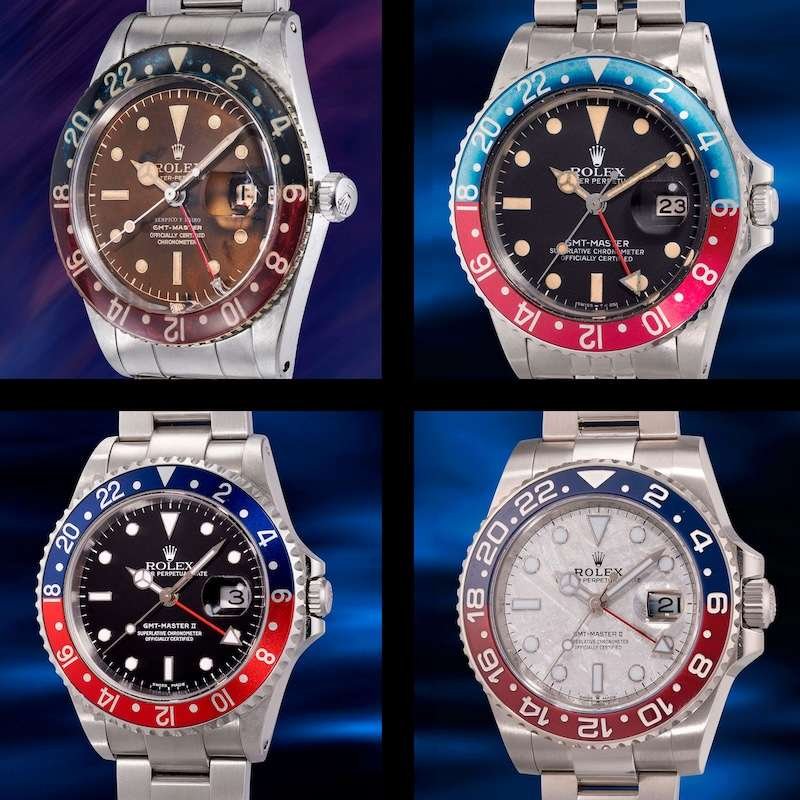
Rolex announced at this 2026 edition of Watches & Wonders the end of the GMT-Master II “Pepsi”, its iconic reference with a red-and-blue two-tone bezel. This decision brings to a close a lineage spanning more than seven decades and representing one of the most continuous threads in the brand’s history.
A reference born in 1954 for Pan American Airways
The original GMT-Master, reference 6542, was introduced in 1954 in collaboration with Pan American World Airways, whose pilots needed a watch capable of displaying two time zones simultaneously. This first model stands out for its Bakelite bezel insert and the absence of crown guards. Its rarity and historical value make it one of the most sought-after references on the secondary market today.
Reference 1675, the backbone of the lineage
Reference 1675, produced from 1959 to 1980, marks a major structural evolution: Rolex introduced crown guards, strengthening the robustness of the case. With more than twenty years of production, the 1675 became the longest-produced reference in the entire GMT-Master line. It is under this reference that the nickname “Pepsi”—a nod to the red and blue colors of the soda brand’s logo—became firmly established in collectors’ vocabulary.
Technical developments in the following decades
Reference 16750, launched in 1981, introduced the quickset date function and the calibre 3075, significantly improving day-to-day usability. The 16700, produced from 1988 to 1999, adopted an anti-reflective sapphire crystal to replace the mineral crystal, while retaining the two-tone aluminum bezel. These two references mark the transition between the vintage era and the model’s gradual modernization.
The return of the Pepsi in white gold in 2018
After a long absence of the red-and-blue configuration in steel from the catalogue, Rolex relaunched the GMT-Master II Pepsi in 2018 in an Oystersteel version with a two-tone Cerachrom ceramic bezel—a technically complex first, as Rolex had to develop a firing process capable of producing two colors on a single ceramic ring. This return sparked immediate enthusiasm, with waiting lists at authorized retailers and grey-market prices quickly exceeding the retail price.
The end of production and its implications for collectors
The announced discontinuation of the GMT-Master II Pepsi ends an almost uninterrupted presence of this colorway in the Rolex catalogue since 1955. For collectors, this discontinuation follows a well-documented pattern: references discontinued by Rolex tend to see their secondary-market value stabilize and then rise as available stock diminishes. Recent Oystersteel examples with Cerachrom bezels, as well as well-preserved vintage versions, are likely to attract increased attention at upcoming auctions.
What these changes mean for the market
The return of Audemars Piguet and Richard Mille—two manufactures whose revenues exceed one billion Swiss francs—significantly strengthens the symbolic and commercial weight of Watches and Wonders 2026. Their absence had been interpreted as a sign of distancing from the collective format; their return suggests that Watches and Wonders has succeeded in convincing powerful independents of the platform’s relevance, particularly in a market context that is more challenging than between 2020 and 2022. Rolex’s decision regarding the Pepsi fits into this broader picture: the 2026 edition combines the show’s expansion with catalogue trade-offs which, taken together, potentially make it the most signal-rich edition since the show was created in its current form.