
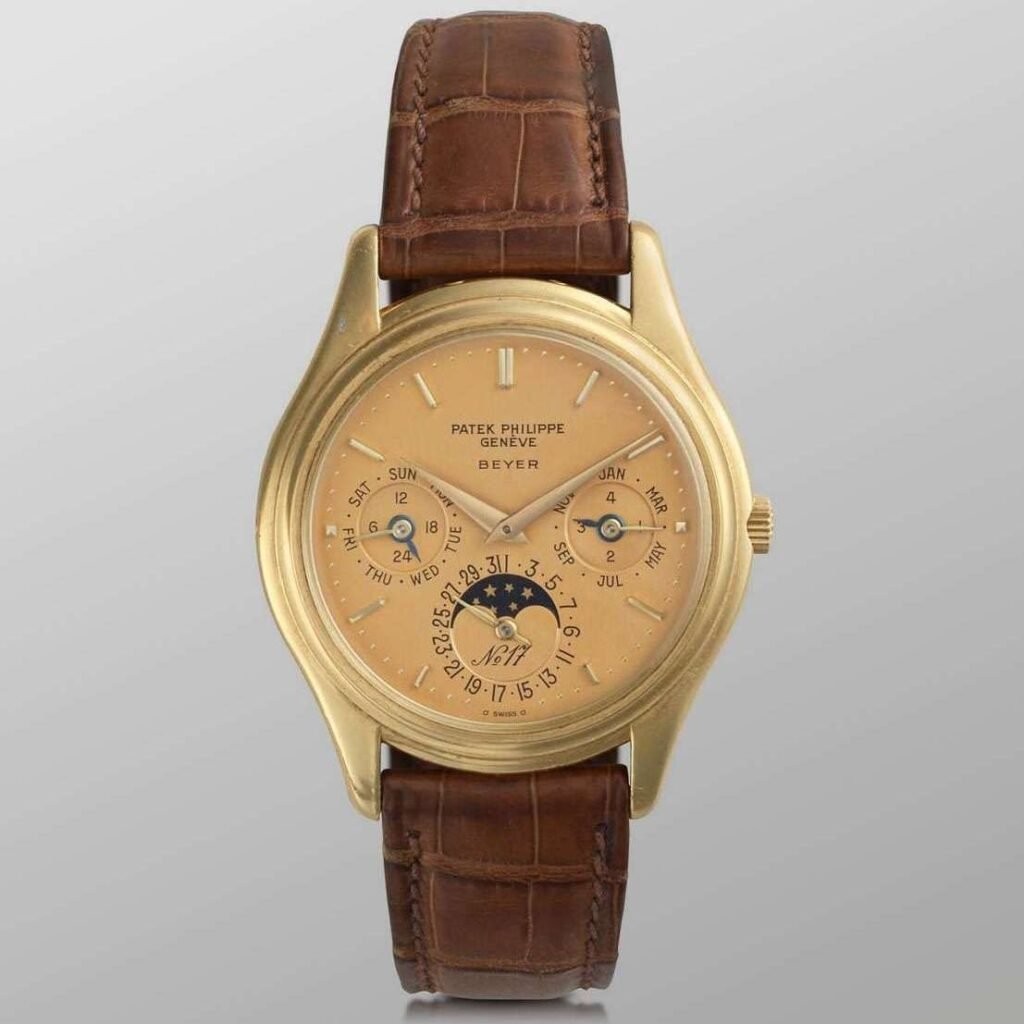
A limited series of 25 pieces for a historic retailer
The Patek Philippe reference 3940 is one of the most important perpetual calendar watches of the late 20th century. In 1985, the House of Beyer in Zurich—one of Europe’s oldest watch retailers, founded in 1760—commissioned a limited series of 25 pieces to mark an event related to its own history, celebrating an anniversary since its establishment. This type of special order, known as a “retailer special edition” in the industry, illustrates Patek Philippe’s practice of customizing production references for its most prestigious authorized retailers.
Reference 3940, a benchmark caliber
The movement that defined a generation
The ref. 3940 is powered by the caliber 240 Q, an automatic movement with a 22-carat gold micro-rotor, remarkably thin in construction. This caliber incorporates a perpetual calendar mechanism—a complication that automatically displays the day, date, month, and leap year without requiring manual correction until 2100. Introduced in 1985, the 3940 succeeded the automatic ref. 3450 and marked the transition to the micro-rotor for this complication at Patek Philippe.
A 36mm yellow gold Calatrava case
The 3940 features a 36mm round case, typical of the Calatrava line, which was subsequently also available in white gold or rose gold depending on the variant, as well as in platinum. The dial displays the perpetual calendar indications with subsidiary dials as well as the 24-hour indication very useful for setting, and a moon phase at 6 o’clock. The sobriety of the design contrasts with the technical density of the movement, which is precisely Patek Philippe’s aesthetic signature for its grand complications in dress watches.
The Beyer commission: context and significance
Beyer Zurich, an authorized Patek dealer for decades
The House of Beyer, located on Bahnhofstrasse in Zurich, has maintained a long-standing business relationship with Patek Philippe. The order for the first 25 pieces of reference 3940 testifies to the friendship between Teddy Beyer and Philippe Stern, who signed his first grand horological complication there. Beyer also has its own watch museum, the Beyer Uhrenmuseum, which houses pieces dating back to antiquity. This unique cultural and commercial positioning allows Beyer to justify special orders from the Geneva manufacturer.
A series of 25 pieces: rarity and traceability
While the order for 25 pieces of ref. 3940 for Beyer in 1985 is documented in certain specialized sources and auction catalogs, it should be noted that the exact archives of the House of Beyer on this type of series, such as our example “Beyer No. 17,” are very precise regarding the date of sale to the final customer. Special editions for retailers are generally distinguished by an inscription engraved on the case back—typically the retailer’s name, the date, or a serial number specific to the order—and sometimes by a slight variation of the dial, as with our example which features the gold variant. These customization elements constitute the ultimate rarity criteria for collectors.
The market value of such a piece
First-generation ref. 3940 in yellow gold (1985–1986) has become a true trophy on the secondary market for all discerning collectors, and the final price varies at auction depending on condition, the presence or absence of the original box and papers. A limited-edition variant bearing documented provenance—such as a Beyer commission with case back engraving and certificate from the House of Beyer—like our example is undoubtedly one of the most coveted pieces to date, as evidenced by the result already achieved last year by Artcurial Beurret Bailly Widmer in June 2025, for the record sum of 330,265 Swiss francs for the version with German calendar “Beyer No. 12.” Recent results prove that this range can be significantly exceeded, with rarity and traceability acting as value multipliers. The last piece from the first series of reference 3950 sold by Phillips New York in December 2025, featuring a gold dial, set the record with a price of $647,700 in December 2025; the piece was complete with accessories and original box.
What determines the value of the “Beyer” special edition
Three criteria to examine when evaluating this historic watch
For a piece claimed as a Beyer 1985 limited edition, three elements are decisive. First, the inscriptions on the dial that explicitly mention “Beyer” and the serial number within the series, such as our example “17.” Next, among all the documents necessary to document the series: the Beyer registry extract (available from the retailer for a fee) confirms the sale date and entry into stock. Finally, the consistency of the movement number with the 1985 period: Patek Philippe produced the 3940 from that year, and the caliber 240 Q numbers of the first pieces are identifiable by perfect case and movement consistency in the manufacture’s archives.
A piece to place in the history of the watch manufacture
The ref. 3940 was produced until 2007, when it was replaced by the ref. 5140. Over its entire production run, pieces from the early years—and especially those from documented special orders—represent a tiny fraction of the total. For a collector or brand historian, a 1985 Beyer example with complete provenance constitutes a collectible object in its own right, independent of its strict market value. The “Beyer No. 17” from the 10 produced with English calendar is all the more historic as it was part of the 1989 auction directed by Osvaldo Patrizzi, Antiquorum Habsburg Feldman, the first thematic sale in history dedicated to Patek Philippe, celebrating the 150th anniversary of the Geneva manufacture.