
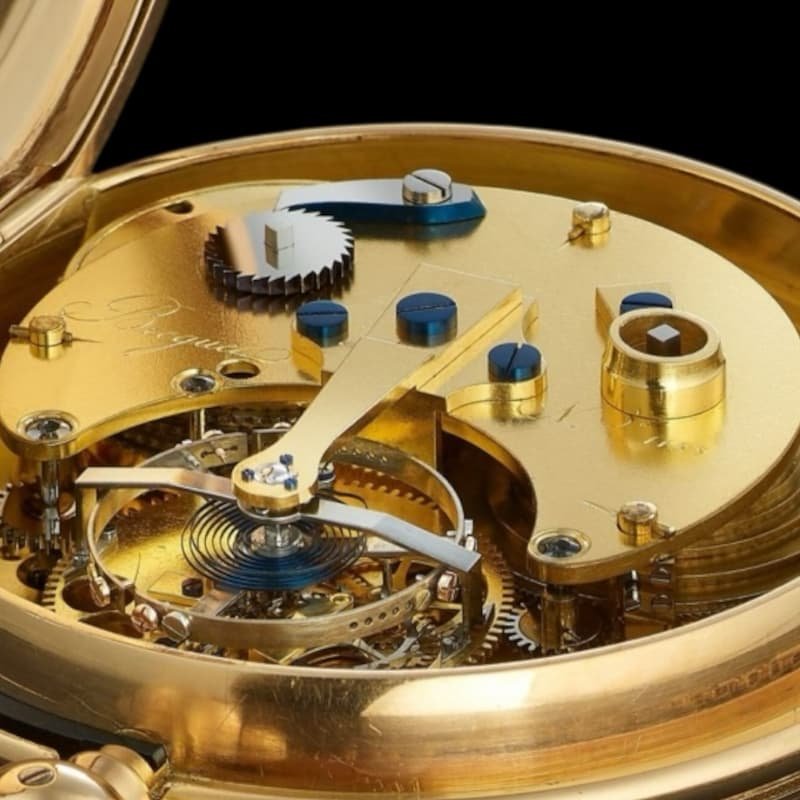
The tourbillon, this fascinating horological complication, originated in 1795 in the mind of Abraham-Louis Breguet, who patented it in 1801. This revolutionary invention aimed to counteract the effects of gravity on the precision of pocket watches, a major technical challenge at the time. Even today, the tourbillon represents one of the pinnacles of horological art, combining technical prowess and mechanical beauty.
The Decisive Relationship Between Breguet and Arnold
The friendship between Abraham-Louis Breguet and the English watchmaker John Arnold played a crucial role in the development of the tourbillon. In the 1780s-1790s, Breguet frequently traveled to London, where he forged a close relationship with Arnold, who was considered one of the best chronometer makers of his time. This collaboration extended to their sons: John Roger Arnold worked for Breguet in Paris, while Louis-Antoine Breguet trained with Arnold in London.
Some historians suggest that Breguet could not have developed the tourbillon without Arnold’s influence. Breguet’s first two tourbillon movements (No. 22 and No. 169) were, in fact, based on Arnold’s movements. A significant gesture attests to this influence: in 1809, Breguet offered tourbillon watch No. 169 to John Arnold’s son, suggesting recognition of his friend’s role in this invention. Although no written document formally proves a co-invention, the exchange of ideas between these two geniuses undeniably contributed to the birth of the tourbillon.
The Birth of a Revolutionary Idea
During his exile in Switzerland, Breguet studied intensely and met many watchmakers in the Jura. His quest for a more precise movement led him to identify the fundamental problem: pocket watches, when worn vertically, suffer from the detrimental influence of gravity on their precision. His solution? To place the balance wheel and escapement in a rotating cage performing a complete revolution per minute, thereby neutralizing positional variations.
The Origin of the Name “Tourbillon”
The term “tourbillon” literally means “whirlwind” in English, but Breguet’s inspiration was more scientific. A man of the Enlightenment, he drew inspiration from the works of René Descartes and Diderot’s Encyclopédie, where the word “tourbillon” referred to a planetary system and its rotation around an axis. This astronomical reference perfectly illustrates the ordered and irresistible movement of the mechanism around a central axis, much like a planet in a galaxy.
A Rare and Precious Complication
The complexity of the tourbillon explains its initial rarity. Breguet only managed to sell his first tourbillon four years after obtaining the patent, and produced only 35 throughout his lifetime, of which only 10 are known today. This technical difficulty makes it a particularly prestigious and sought-after complication.
The Evolution Towards Wristwatches
The tourbillon remained confined to pocket watches for a long time. It was not until 1945 that what was probably the first tourbillon movement for a wristwatch appeared, created by André Bornand for Patek Philippe. Shortly after, in 1948, the French manufacturer Lip produced a unique tourbillon wristwatch, while Omega launched a similar limited series.
The Renaissance of the Tourbillon
After the quartz crisis, the tourbillon experienced a spectacular resurgence in the early 2000s. Brands then used it as a showcase for their technical expertise, triggering a veritable horological “arms race.” This period saw the emergence of increasingly complex variations: flying tourbillons, double tourbillons, multi-axis tourbillons, ultra-thin tourbillons, and many other innovations.
The Contemporary Importance of the Tourbillon
While the practical utility of the tourbillon may be debated in the era of modern technologies, its symbolic and aesthetic value remains undeniable. The manufacture of a tourbillon requires hundreds of hours of meticulous work by master watchmakers, with components measuring fractions of a millimeter. Each element requires extensive manual finishing, testifying to traditional craftsmanship rarely observed in modern manufacturing.
The Tourbillon as a Symbol of Excellence
Today, the tourbillon transcends its original function to become a symbol of horological excellence. Its presence in a watch testifies not only to the manufacturer’s technical mastery but also to its commitment to horological tradition. The rotating cage, often visible through a dial opening, offers a fascinating mechanical spectacle that captivates collectors and enthusiasts.