
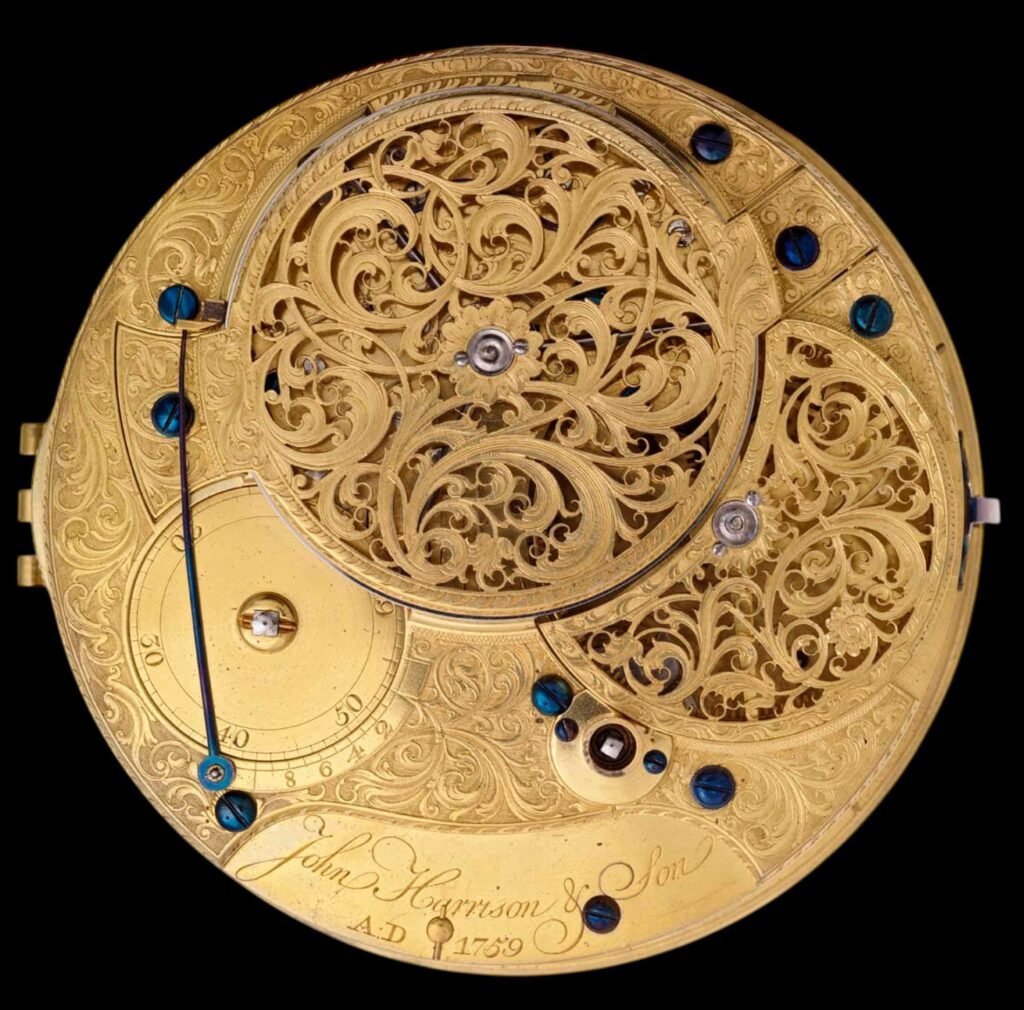
The marine chronometer represents one of the most crucial technological advancements in the history of navigation. Born from a vital need to determine longitude at sea, this precision instrument revolutionized maritime travel in the 18th century. Its development engaged the greatest minds of the era and forever changed our relationship with navigation.
The Longitude Problem in Navigation
For centuries, sailors could determine their latitude (north-south position) by observing celestial bodies with a sextant, but longitude (east-west position) remained a mystery. This inability to precisely position themselves on the east-west axis regularly caused catastrophic shipwrecks. One of the most tragic was the naval disaster off the Isles of Scilly in 1707, where four British warships ran aground on rocks, leading to the death of 1,550 sailors.
The National Stakes and the Longitude Act of 1714
Faced with these considerable human and economic losses, the British Parliament adopted the Longitude Act in 1714. This law offered a substantial reward of 10,000 to 20,000 pounds sterling (several million in current value) to anyone who could solve the longitude problem. The challenge was clear: for a chronometer to be useful for navigation, it had to maintain extraordinary accuracy of a few seconds per day for weeks, even in the difficult conditions of a ship at sea.
Early Attempts and the Pendulum Clock
The Dutch mathematician and physicist Christiaan Huygens was among the first to tackle the problem with his pendulum clocks. His most precise models deviated by only 10 seconds per day, a remarkable performance for the time. However, these clocks proved unusable at sea: the rocking of ships completely disrupted the pendulum mechanism, making any precise measurement impossible.
John Harrison and His Four Chronometers
The true hero of this story is John Harrison, a self-taught carpenter and clockmaker from Yorkshire. From 1730, Harrison dedicated his life to solving the longitude problem, successively producing four marine chronometers, simply designated H1, H2, H3, and H4. The first three used ingenious systems to counteract the ship’s movements, including interconnected balances and a grasshopper escapement that eliminated the need for lubricants.
The Triumph of H4
After decades of work, Harrison completed his masterpiece, H4, in 1761. Unlike his previous creations, which resembled clocks, H4 was shaped like an oversized pocket watch. This chronometer incorporated several revolutionary innovations: a large balance wheel beating at 18,000 alternations per hour, a winding system operating every seven and a half seconds, and a thermal compensation mechanism maintaining constant operation despite temperature variations.
The Decisive Test
In November 1761, William Harrison, John’s son, embarked aboard the HMS Deptford for a voyage from Portsmouth to Jamaica, taking H4 with him. During this voyage, the chronometer demonstrated its value by accurately predicting the approach of land. After 81 days of navigation, H4 had lost only 3 minutes and 36.5 seconds, an error margin of approximately one nautical mile in longitude – an unprecedented accuracy.
The Legacy of the Marine Chronometer
The success of H4 radically transformed maritime navigation. In the following decades, clockmakers like John Arnold, Thomas Earnshaw, and Louis Berthoud refined Harrison’s design, making marine chronometers more reliable and less expensive to produce. These instruments became standard on all important ships, significantly reducing navigation risks and accelerating the colonial and commercial expansion of European powers.
The Impact on Modern Watchmaking
The influence of the marine chronometer extends far beyond navigation. The innovations developed by Harrison, such as the thermal compensation system and anti-shock mechanisms, continue to inspire contemporary watchmakers. Brands like Charles Frodsham & Co. and independent watchmakers like Raúl Pagès perpetuate this legacy in their modern creations, testifying to the lasting importance of this technological advancement.