
George Daniels (1926-2011) represents a revolutionary figure in the modern watchmaking world. Considered the greatest watchmaker of the 20th century, this self-taught British craftsman transformed the approach to watch manufacturing and inspired an entire generation of independent creators. His technical and philosophical legacy continues to profoundly influence contemporary watchmaking, particularly through his Co-Axial escapement and his integral manufacturing method.
The Journey of a Self-Taught Genius
George Daniels began his watchmaking journey without formal training, learning traditional techniques on his own. Born into a modest background in London, he discovered watchmaking at the age of five by disassembling a pocket watch. This early fascination led him to master all facets of the craft, from design to the complete manufacturing of watches. His exceptional ability to hand-make every component, without industrial assistance, earned him international recognition in a field then dominated by Swiss manufacturers.
The Co-Axial Escapement, a Technical Revolution
Daniels’ most significant contribution to modern watchmaking remains the Co-Axial escapement, developed in the 1970s. This technical innovation solves several problems inherent in the traditional Swiss lever escapement, particularly by reducing friction and improving long-term chronometric stability. After years of solitary development, Omega adopted this technology in 1999, commercializing it on a large scale and thus validating Daniels’ genius. This escapement represents the first major innovation in mechanical watchmaking in nearly 250 years.
The Daniels Method of Integral Manufacturing
Daniels developed a unique approach to watchmaking known as the “Daniels Method.” This philosophy advocates for the entirely manual creation of a watch by a single watchmaker, from initial design to the final case, including every gear and bridge of the movement. This method, requiring mastery of over 30 different crafts, radically opposes industrial production and excessive specialization. It represents the pinnacle of creative independence in watchmaking and has inspired many contemporary artisans.
Iconic Creations
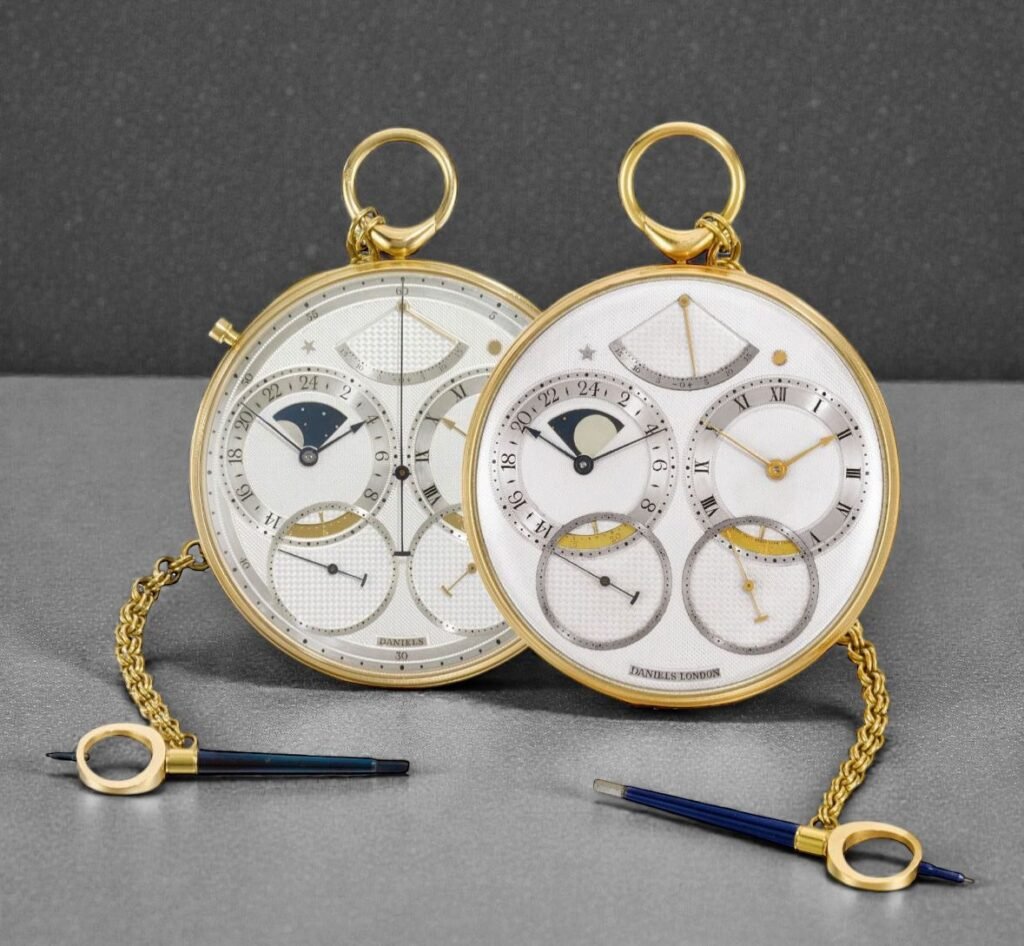
During his career, Daniels produced only about 37 watches entirely by hand, each representing hundreds of hours of work. Among his most famous creations is the “Space Traveller,” a double-escapement pocket watch simultaneously displaying mean solar time and sidereal time. Sold for over $4.5 million at auction, it illustrates the complexity and ingenuity of his work. His watches are characterized by exceptional finishes and innovative complications, often presented in gold cases with classic proportions.
Roger Smith, the Spiritual Heir
The relationship between George Daniels and Roger Smith constitutes an essential chapter of this legacy. After attempting to impress Daniels with his first watch, Smith was advised to start over completely. Five years later, his second attempt convinced Daniels to take him on as his sole apprentice. Today, Smith is recognized as the only watchmaker capable of fully applying the Daniels method. From his workshop on the Isle of Man, he perpetuates this tradition while developing his own creative identity, producing fewer than five watches per year.
Influence on Contemporary Independent Watchmaking
Daniels’ impact extends far beyond his own work. Creators like François-Paul Journe, Kari Voutilainen, and Philippe Dufour openly acknowledge his influence on their approach. The current independent watchmaking movement, which values manual craftsmanship, technical innovation, and personal signature, owes much to his example. Daniels demonstrated that an individual could compete with major manufacturers in terms of innovation and excellence, paving the way for a new generation of artisan-creators.
Institutional and Academic Recognition
Beyond his practical work, Daniels contributed to the preservation and transmission of watchmaking knowledge. His book “Watchmaking,” published in 1981, remains the absolute reference for watchmakers aspiring to integral manufacturing. Recognized by the British Crown with an MBE and then a CBE, he also received numerous academic distinctions. The George Daniels Educational Trust, established after his death, continues to support the training of new talents in watchmaking, thus perpetuating his vision of artisanal excellence.
The Market and Auction Legacy
Daniels’ creations today reach dizzying heights at auction sales, reflecting their historical importance and rarity. In 2019, his watch “Space Traveller II” set a record at $4.6 million at Sotheby’s in London. This exceptional valuation testifies to the late but decisive recognition of his genius. More broadly, the growing interest of collectors in independent watchmaking follows in Daniels’ footsteps, who redefined the notion of value in horology by prioritizing authentic craftsmanship over industrial production.
Watchmaking Philosophy and its Contemporary Impact
Daniels’ vision transcends pure technique to embrace a philosophy of watchmaking as a total art. He believed that a watch should be beautiful, functional, and durable, embodying the highest values of human craftsmanship. This holistic approach resonates particularly today, in an era of rapid consumption and planned obsolescence. Young independent brands like Akrivia, Rexhep Rexhepi, or Simon Brette follow in this tradition, seeking to create timepieces that will endure for generations while bearing the distinctive imprint of their creator.